

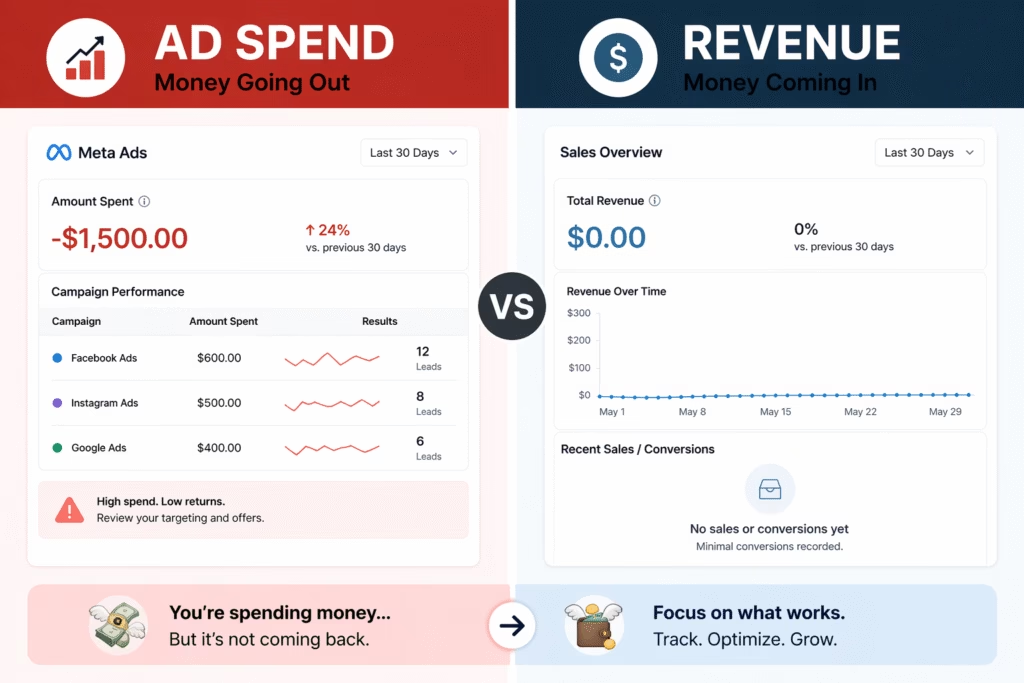
You wake up, check your bank account, then check your ad dashboard. You spent $1,500 last week on Google Ads, Facebook promotions, and an email tool. But did you make that money back? Did you make more?
If your answer is “I honestly have no idea,” you are not alone.
Learning how to measure marketing ROI — and understanding which activities actually bring in customers — is the number one challenge for small business owners today. Surveys show that 23% of owners rank this as their single biggest marketing headache, with only 18% feeling confident their marketing is paying off, down from 27% just a year ago. (Source: SimpleTexting Small Business Marketing Report, 2024)
Confidence is falling. But it’s not because you’re bad at business. It’s because digital marketing has become a black box that nobody explains in plain English.
This guide is for you if you are tired of guessing. Here is exactly how small business owners can finally measure marketing ROI — without a marketing degree or expensive software.

Why Most Small Businesses Struggle to Measure Marketing ROI
The problem usually isn’t that your marketing is failing. The problem is that you are measuring the wrong things.
Most ad platforms show you “impressions,” “clicks,” “likes,” and “reach.” Those numbers feel good, but they don’t pay your rent. You can have a million impressions and zero sales. You can have a thousand likes and still lose money.
The second problem is overwhelm. You are expected to manage Google, Facebook, Instagram, TikTok, email, SMS, and SEO — all at once. Each platform has its own dashboard, its own jargon, and its own way of burying what really matters. So you end up doing a little bit of everything and hoping something sticks.
Hope is not a marketing strategy.
Here is a simple, five-step process to fix this — starting today.
Need help tracking your marketing? Let’s fix it
Step 1: Pick ONE Number That Means “Success”
The fastest way to measure marketing ROI is to stop tracking everything and track the one number that actually matters to your business.
Ask yourself: If this number went up,would I know my marketing is working?
For most small businesses, that number is one of these:
- Total revenue from new customers this month
- Number of new paying customers
- Booked appointments (for service businesses)
- Phone calls that converted into sales
Write that number down. Put it on a sticky note on your screen. Every marketing decision you make from today will be judged against it — not likes, not reach, not open rates. Those are distractions.
Real example: A local plumber stopped tracking his Facebook follower count and started tracking phone calls that turned into booked jobs. Within 60 days, he knew his Google listing was driving 80% of his calls — and he cut his Facebook ad spend entirely.
Step 2: Ask Every New Customer How They Found You
This is the single most powerful (and most overlooked) way to measure marketing ROI. It costs nothing and gives you honest, real-world data no algorithm can fake.
If you meet customers in person or by phone, ask every single person: “How did you hear about us?” Keep a small notebook at your counter, or add a dropdown to your enquiry form. After 20–30 answers, you will see a clear pattern — and that pattern tells you exactly where to spend your next marketing pound or dollar.
If you sell through a website, install Google Analytics 4 — it’s completely free. It works like a security camera for your site, showing you which traffic came from which source, and crucially, which traffic actually bought something. Setup takes about 15 minutes and there are dozens of free tutorials on YouTube.
If you run paid ads on Google, Meta, or TikTok, turn on conversion tracking inside each platform. This tells you, dollar for dollar: “This specific ad generated $X in sales.” If an ad is in the red — you spent more than you made — turn it off. If it’s profitable, increase the budget. That is how you measure marketing ROI without guesswork.
Download our free Monthly Marketing Scorecard — it takes five minutes to fill in and shows you exactly where your customers are coming from each month.
Step 3: Run a Simple Two-Week “Turn It Off” Test
You don’t need a fancy A/B test to figure out what’s working. You just need to compare two weeks.
Week one (your normal week): Do exactly what you’ve been doing. Write down your total sales.
Week two (your test week): Turn off one marketing channel only — for example, pause all Facebook posts and ads. Keep everything else identical.
Then compare: Did your sales drop in week two?
- If yes — that channel is driving real business. You now have proof. Keep it and invest more.
- If no — that channel is consuming your time or money without results. Cut it without guilt.
Repeat this test for email, Google Ads, or any other activity you’re unsure about. It takes two weeks and costs nothing except a little discipline.

Step 4: Stop Celebrating Vanity Metrics
Vanity metrics are numbers that make you feel good but don’t predict a single extra sale. They include:
- Likes and hearts
- Shares and comments
- Email open rates
- Website visits (without purchases)
- Follower counts
None of these pay your bills. They can grow while your revenue falls — and that happens more often than most business owners want to admit.
Instead, track only money metrics. There are three that matter:
Cost per new customer — take your total marketing spend for the month and divide it by the number of new customers you acquired. This tells you what it costs to buy a customer, channel by channel.
Return on ad spend (ROAS) — divide the revenue generated from your ads by what the ads cost. A result above 1x means you’re making money. Below 1x means you’re losing it.
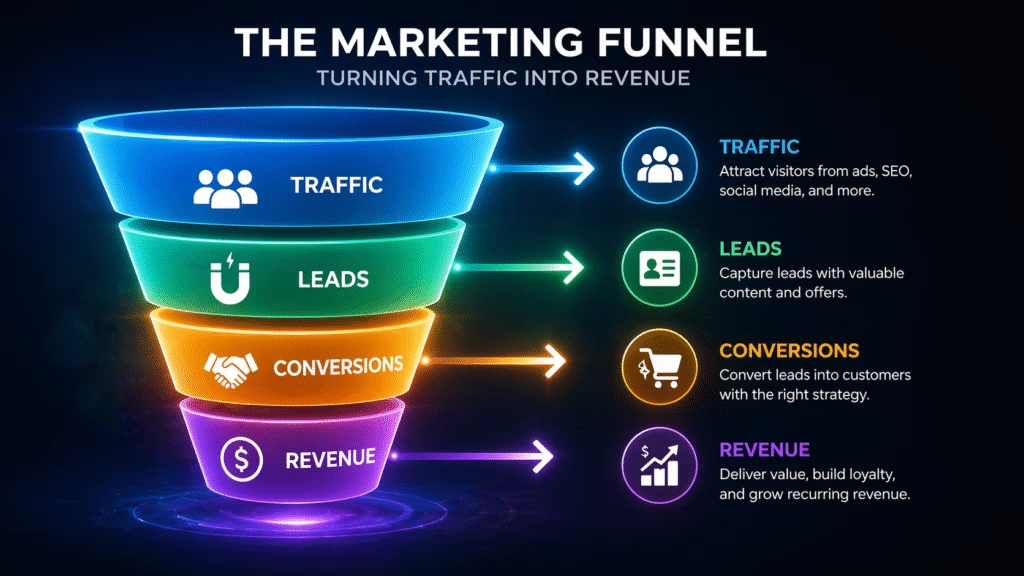
Conversion rate — out of every 100 people who visit your site or enquire, how many actually buy? Even moving this from 2% to 3% can add thousands to your monthly revenue without spending a penny more on ads.
If you track only these three numbers, you will never again say “I don’t know if my marketing is working.”
Download our free Monthly Marketing Scorecard — it takes five minutes to fill in and shows you exactly where your customers are coming from each month.

Step 5: Do a 15-Minute Marketing Check Every Friday
This is the habit that ties everything together. Set a recurring Friday reminder and spend 15 minutes answering three honest questions:
- What did I spend on marketing this week? — Include ads, tools, agency fees, and your own time if you’re doing it yourself.
- How many new customers or sales came in?
- For each marketing activity, can I say yes or no to whether it paid for itself?
If you cannot answer question three for a specific activity, that activity is on a two-week probation. Give it a fair test. If you still cannot see a connection between spending and sales, cut it. No exceptions.
This Friday review takes less time than scrolling your social feeds, and it will do more for your business than any tool or tactic you read about online.
The Bottom Line
Measuring marketing ROI does not require perfect data, fancy software, or a marketing degree. It requires one habit: connecting your spending to your customers.
Start simple. Pick one success metric. Ask every customer how they found you. Test channels one at a time. Ignore the vanity numbers. Do your Friday check.
Within 30 days, you will know more about what’s working in your marketing than most business owners ever figure out — and you’ll stop throwing money into the dark.
Frequently Asked Questions
What is a good marketing ROI for a small business? A common benchmark is 5:1 — meaning $5 in revenue for every $1 spent on marketing. For businesses with tight margins, 3:1 may be the minimum to stay profitable. For high-margin products or services, you may aim higher. The most important thing isn’t hitting a benchmark — it’s knowing your own number and improving it over time.
How do I track marketing ROI without expensive tools? Start with two free tools: a notebook to record where customers come from, and Google Analytics 4 to track your website traffic. These two alone will answer 80% of your marketing questions before you need to invest in anything else.
How long does it take to see if a marketing channel is working? Give any new channel at least four weeks of consistent effort before judging it. Seasonal businesses may need to compare year-over-year. The two-week turn-off test described in Step 3 is a reliable shortcut for channels you’ve been running for some time.
Found this useful? Share it with another business owner who feels like they’re spending money on marketing but not seeing results. And if you want a ready-made tool to track all of this, download our free Monthly Marketing Scorecard — it takes five minutes to fill in and shows you exactly where your customers are coming from each month.
About the author: [Your Name] is a [your title] who has worked with [X] small businesses to simplify their marketing and track results that actually matter. [One sentence about your experience or approach.]
