

A practical guide for patients, families and caregivers

The Internet Can Inform You – or Put Your Health at Risk
A new symptom, diagnosis or prescription can send almost anyone to the internet. Within seconds, you can find medical articles, patient stories, videos, product advertisements, discussion forums and confident answers from people you have never met.
Some of that information can help you understand unfamiliar terms, prepare questions for an appointment and learn about treatment options. Some is incomplete, outdated, designed to sell a product or simply false. The difficulty is that unreliable health content can look just as polished and convincing as trustworthy information.
The consequences are not limited to confusion. Misleading advice may cause someone to delay urgent care, stop a prescribed medicine, combine unsafe products or spend money on an unproven treatment. Even technically accurate information can be harmful when it is applied to the wrong person or taken out of context.
You do not need to distrust everything online. You need a repeatable way to judge what you find and understand what online information can – and cannot – do.
This guide provides ten practical checks for finding reliable health information online, recognizing health misinformation and using what you learn to have safer, more productive conversations with qualified healthcare professionals.
What Online Health Information Can and Cannot Do
It Can Help You Learn
Good health information can explain a condition in plain language, describe common symptoms, outline how a test works and help you prepare questions. It can also point you toward public-health guidance, patient-support services and professional care.
It Cannot Diagnose Your Individual Situation
An article cannot examine you, review your complete medical history or know every medicine and supplement you take. Symptom checkers and artificial-intelligence tools may organize possibilities, but they can miss emergencies, overstate common explanations or provide advice that does not fit your circumstances.
Use online content as a starting point for understanding, not as proof that you have or do not have a particular condition.
It Should Not Replace Urgent Care
If you may be experiencing a medical emergency, do not spend time trying to confirm the diagnosis online. Contact the appropriate local emergency service or seek urgent professional care. Warning signs vary, but severe difficulty breathing, signs of stroke, heavy bleeding, loss of consciousness, severe allergic reaction and thoughts of self-harm require immediate attention.
| Safety rule: Do not stop, start or change a prescription medicine because of an article, video, comment or AI-generated answer. Speak with the prescribing clinician or a qualified pharmacist. |
10 Checks for Reliable Health Information Online
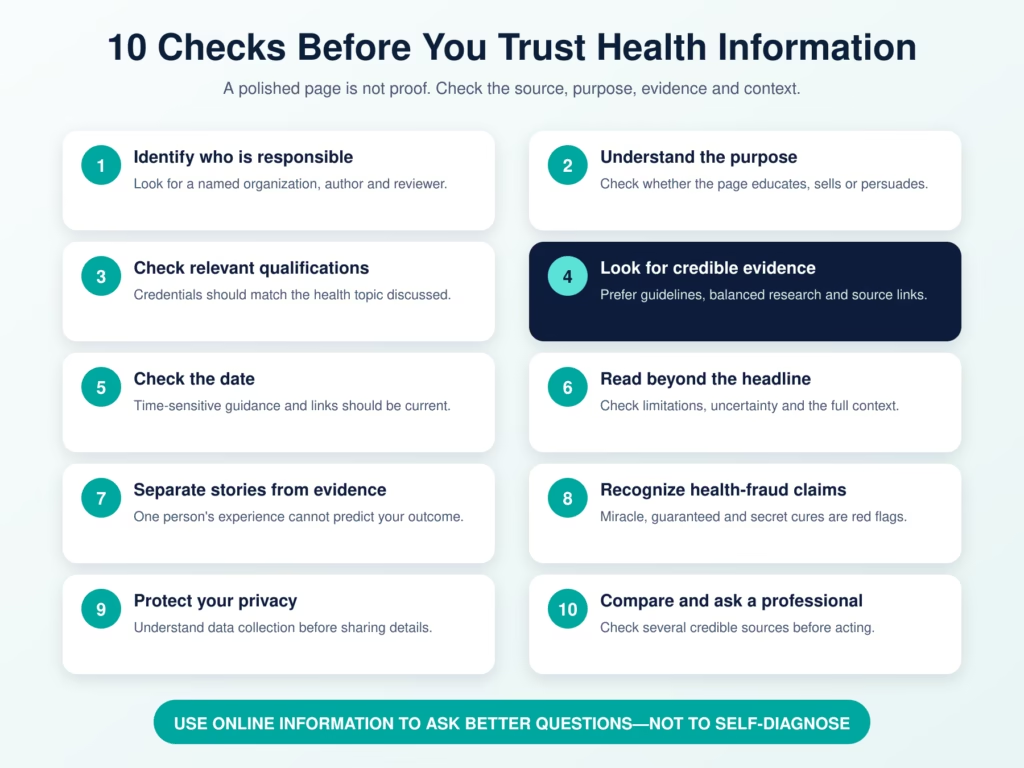
1. Identify Who Is Responsible for the Information
Start with the provider. Is the website run by a government health agency, medical school, hospital, professional association, nonprofit organization, news company, commercial business or individual creator? Look for an About page, editorial policy, physical or professional contact details and the name of the organization responsible.
A credible-sounding domain name is not evidence by itself. Anyone can create a website or social-media profile that appears clinical. Logos, white coats and words such as institute, laboratory or doctor do not prove that an organization is legitimate.
MedlinePlus recommends asking who runs the site, why it exists and whether the owners can be contacted. Use the MedlinePlus evaluation checklist.
2. Understand the Purpose and Who Pays for It
Ask what the content is trying to make you think or do. Is it intended to educate, attract advertising, collect personal information, build an audience or sell a consultation, supplement, test or device?
Commercial funding does not automatically make information false, but it creates an interest that should be visible. Advertisements should be labelled. Sponsored content and affiliate links should be disclosed. If every article leads to the same product, the site may be using education primarily as a sales funnel.
Be especially cautious when the person explaining the problem also sells the only solution they recommend.
3. Check the Author’s Qualifications – and Their Relevance
Look for the author’s full name, qualifications and professional role. Then ask whether that expertise is relevant to the claim. A healthcare credential in one field does not create authority in every area of medicine.
Good consumer-health content often includes medical review details as well as the writer’s name. Confirm that the reviewer is identifiable and that the review date is reasonably current. Anonymous content is not automatically wrong, but it gives you less information with which to judge accountability.
On social media, popularity is not a medical qualification. A large following, verified badge or persuasive personal story does not establish clinical expertise.
4. Look for Evidence, Not Just Confidence
Reliable health content explains where its information comes from. Look for links or references to clinical guidelines, government health agencies, systematic reviews, peer-reviewed studies or established professional organizations.
A link to a study does not settle the question. Consider whether the article accurately represents the research. A laboratory or animal study cannot automatically show that the same effect occurs in people. A small observational study cannot prove cause and effect. One new paper rarely overturns an entire body of evidence on its own.
Be cautious with phrases such as research proves when no research is identified, or when the cited source does not support the headline.
5. Check the Date and Whether Guidance Has Changed
Health recommendations change as evidence, treatments and disease patterns evolve. Look for the publication date, last medical-review date and any update notice. Check whether the links still work and whether the cited guideline remains current.
Older information may still be accurate, especially for stable topics, but time-sensitive subjects require recent sources. These include outbreaks, recalls, medicine warnings, screening recommendations and regulatory approvals.
WHO advises readers to assess the source, go beyond the headline, identify the author and check the date before sharing health information. Read WHO’s infodemic guidance.
6. Read Beyond the Headline and Check the Context
Headlines are designed to win attention. They may turn an association into a cause, describe a preliminary result as a breakthrough or omit important limitations. Read the complete article and compare the headline with what the evidence actually says.
Watch for missing context: who participated in the research, how many people were studied, how long they were followed, what outcome was measured and whether the result applies to people like you. Relative-risk claims can also sound dramatic without the underlying numbers.
If a post says a habit doubles risk, ask what the original risk was. An increase from one case in 10,000 to two is different from an increase from one in ten to two in ten.
7. Separate Personal Experience From General Evidence
Patient stories can provide comfort and reveal what living with a condition feels like. They can also help people prepare for questions that formal medical pages overlook. But one person’s outcome cannot predict yours.
A symptom may have many causes. A treatment that helped one person may be unsuitable or unsafe for another. Online communities can support people emotionally, but they should not pressure members to reject professional advice or present individual experience as universal proof.
Treat testimonials as experiences, not clinical trials.

8. Recognize the Warning Signs of Health Fraud
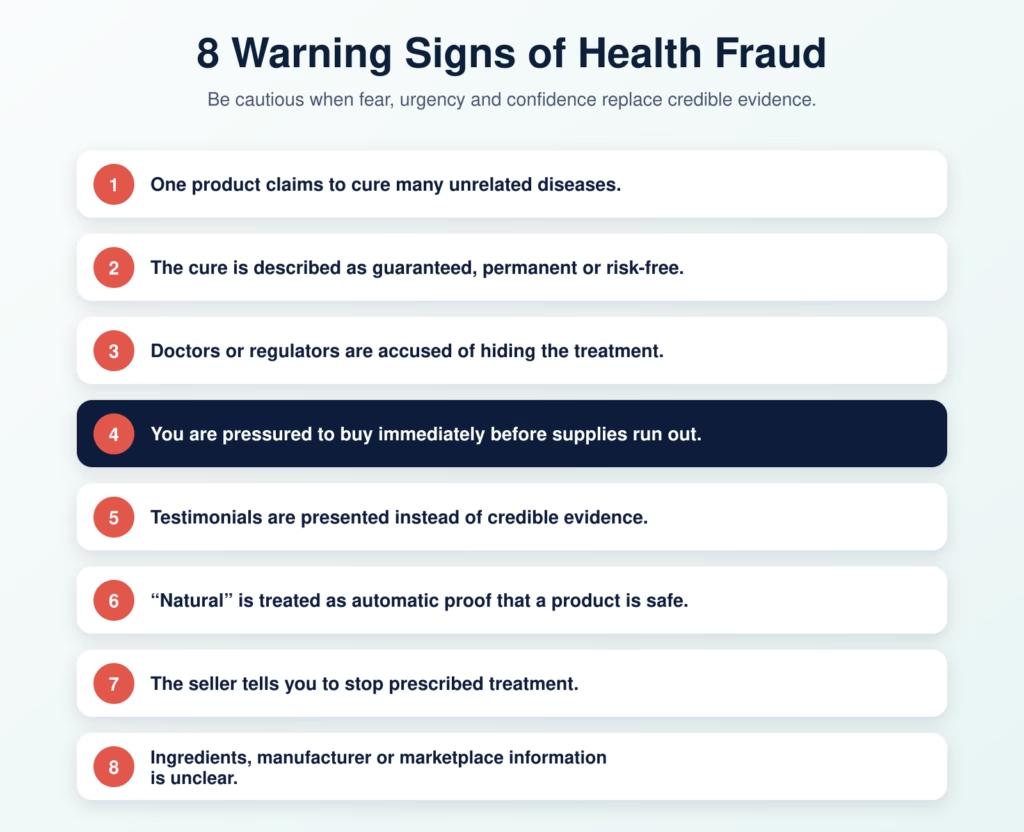
Health fraud often targets fear, pain and conditions with limited treatment options. Warning signs include:
- Claims that one product cures many unrelated diseases.
- Promises of a guaranteed, permanent or risk-free cure.
- Statements that doctors or regulators are hiding the treatment.
- Pressure to buy immediately because supplies are limited.
- Testimonials presented instead of credible evidence.
- Claims that natural automatically means safe.
- Instructions to stop prescribed treatment.
- Products sold through unfamiliar marketplaces with unclear ingredients or manufacturers.
The FDA defines a fraudulent health product as one deceptively promoted as effective against a disease or condition without being scientifically proven safe and effective for that purpose. See the FDA’s health-fraud warning signs.
No regulatory database is complete, but checking warnings and recalls can reveal known concerns. The absence of a warning does not prove that a product works.
9. Protect Your Privacy Before Searching, Clicking or Sharing
Health searches can be deeply personal. Before entering symptoms, diagnoses, identification numbers, insurance details or medical records, check who operates the service and how the information will be used.
Read the privacy notice before completing quizzes, joining patient communities or using symptom and AI tools. Look for information about data sharing, advertising, deletion and whether the service is covered by health-privacy laws. Do not assume every health app or website has the same obligations as a hospital or clinic.
Avoid posting identifiable records, prescription labels or test results publicly. If you need to send information to a healthcare provider, use the channel they recommend.
10. Compare Credible Sources and Ask a Professional
Do not rely on the first result, even when it supports what you hoped to hear. Compare information from several high-quality sources. Look for areas of agreement, differences in recommendations and signs that the evidence is uncertain or evolving.
MedlinePlus recommends checking several high-quality websites because no single source can guarantee perfect information. Read the MedlinePlus conclusion.
Bring the information to a qualified professional when it may affect a health decision. A useful question is not simply, ‘Is this article true?’ Ask how the information applies to your symptoms, medical history, medicines and goals.
A Quick Credibility Checklist
| Question | What to look for | Warning sign |
| Who? | Named organization, author and relevant reviewer | Anonymous authority or unrelated credentials |
| Why? | Clear educational purpose and disclosed funding | Hidden sales motive or undisclosed sponsorship |
| Evidence? | Guidelines, credible studies and balanced explanation | Testimonials or one study presented as proof |
| When? | Publication and review dates; current links | No date or outdated time-sensitive advice |
| How stated? | Measured language, benefits, risks and uncertainty | Miracle, guaranteed, secret or risk-free claims |
| Privacy? | Clear policy and limited, explained data collection | Unnecessary personal data or unclear sharing |
| Verified? | Agreement across several credible sources | A claim found only in copied posts or sales pages |
How to Use Online Health Information in a Medical Appointment
Online research can make an appointment more productive when it is organized around questions rather than a self-diagnosis.
- Save the original link, not only a screenshot.
- Write down the main claim in your own words.
- Note what symptoms or concerns led you to search.
- List every prescription medicine, over-the-counter product and supplement you use.
- Ask whether the source is credible and whether the information applies to you.
- Ask about benefits, risks, alternatives and what happens if you wait.
- Confirm which warning signs should lead you to seek urgent care.
A clinician may disagree with an article for reasons that are not visible online: another condition, a medicine interaction, a diagnostic result or a guideline that applies differently to your situation. Ask for the reasoning rather than treating the conversation as a contest between the internet and the professional.
Special Risks on Social Media and AI Tools
Social Media Rewards Attention, Not Accuracy
Algorithms often promote content that attracts reactions and keeps people watching. Emotional claims, dramatic transformations and conflict can travel further than careful explanations. Repetition can make a claim feel familiar without making it true.
Pause before sharing. Find the original source, read beyond the caption and check whether a recognized health authority has addressed the claim. WHO advises people to think critically and pause before passing on health-related misinformation.
AI Can Produce Fluent but Incorrect Answers
AI tools can summarize topics and help generate questions, but fluent language is not proof of accuracy. An AI system may invent sources, omit contraindications, misunderstand a prompt or provide outdated information. It may also respond differently when the same question is phrased another way.
Do not rely on an AI answer for diagnosis, emergency triage, medicine dosing or changes to treatment. Verify important claims through authoritative sources and a qualified healthcare professional. Avoid entering identifiable medical information unless you understand how the service stores and uses it.
When to Stop Searching and Seek Professional Care
More information does not always produce more clarity. Contact an appropriate healthcare professional when:
- Symptoms are severe, sudden, worsening or persistent.
- You may be experiencing an emergency.
- You are pregnant, immunocompromised or managing a serious condition.
- The advice involves changing a prescription medicine.
- A product could interact with medicines or another condition.
- Different credible sources give conflicting recommendations.
- Online searching is increasing anxiety without helping you decide what to do.
If cost, location or access is preventing you from seeking care, look for legitimate public-health services, community clinics, telehealth options or patient-assistance resources in your area. Do not allow a product seller to become your only source of medical advice.
Common Mistakes When Evaluating Health Information
- Trusting a result because it appears first in search.
- Assuming a professional-looking website is medically reviewed.
- Judging credibility by follower count or video production quality.
- Reading only the headline or social-media caption.
- Treating one study as final proof.
- Confusing correlation with causation.
- Assuming natural products cannot cause harm or interactions.
- Searching repeatedly until one source confirms a preferred answer.
- Using a testimonial as evidence that a treatment will work for everyone.
- Sharing alarming content before checking the original source.
- Entering sensitive information without reading the privacy policy.
- Changing treatment without speaking to a qualified professional.
Frequently Asked Questions
How Can I Find Reliable Health Information Online?
Start with government health agencies, major medical schools, established hospitals and recognized professional or nonprofit organizations. Check who runs the site, its purpose, author qualifications, evidence, review date, funding and privacy practices. Compare several credible sources before acting.
What Makes a Health Website Trustworthy?
A trustworthy health website identifies the responsible organization, provides contact information, separates advertising from editorial content, names qualified authors or reviewers, cites credible evidence, updates its content and explains how personal information is handled.
Can I Trust Health Information on Social Media?
Some qualified professionals and health organizations publish useful social content, but the platform itself does not verify every medical claim. Check the creator’s relevant qualifications, find the original evidence and confirm important information through authoritative sources before sharing or acting.
Are Patient Testimonials Reliable Health Evidence?
Testimonials describe individual experiences and may provide emotional support, but they cannot establish that a treatment is safe or effective for everyone. Outcomes can be influenced by diagnosis, other treatment, natural recovery and factors the testimonial does not mention.
How Can I Recognize a Health Fraud Scam?
Be cautious of miracle cures, guaranteed results, secret treatments, claims that one product treats many diseases, pressure to buy immediately and advice to reject established care. Check official warning and recall information and discuss products with a qualified professional.
Can AI Give Reliable Medical Advice?
AI can explain general concepts and help organize questions, but it can also generate incorrect, incomplete or outdated information. It should not replace professional diagnosis, emergency care or individualized treatment advice. Verify important claims and protect identifiable health information.
Should I Tell My Doctor What I Read Online?
Yes, especially if the information may affect treatment or concerns you. Bring the link and explain what you understood. Ask whether the source is credible, how the claim applies to you and what benefits, risks or alternatives should be considered.
Use the Internet to Ask Better Questions – Not to Take Bigger Risks
Online health information is most useful when it helps you understand a topic, recognize what you do not know and prepare for a conversation with a qualified professional. It becomes dangerous when a confident claim is treated as an individual diagnosis or when a seller’s promise replaces evidence.
Before trusting a health page, identify who is responsible, why it exists, what evidence it uses and when it was reviewed. Read beyond the headline. Separate personal experience from general evidence. Protect your privacy and compare several credible sources.
Most importantly, match the level of verification to the level of risk. A low-stakes question may require only a reliable explanation. A decision involving urgent symptoms, prescription medicines, pregnancy, a serious diagnosis or an unproven product deserves professional guidance.
The internet should help you participate in your care more confidently. It should never pressure you to gamble with your health.
About the Author
| Irene Wanyama is a healthcare SEO content writer with professional experience in pharmacy operations, digital marketing and customer education. She creates clear, evidence-informed content that helps healthcare organizations communicate responsibly and build trust with their audiences. |
Portfolio and enquiries: neksasdigital.com | WhatsApp Irene
Selected Sources
- MedlinePlus. Checklist: Evaluating Internet Health Information.
- MedlinePlus. Evaluating Health Information.
- National Institute on Aging. How To Find Reliable Health Information Online.
- World Health Organization. Let’s flatten the infodemic curve.
- World Health Organization. Global principles for credible health sources.
- US Food and Drug Administration. Health Fraud Scams.
- US Food and Drug Administration. Six Tip-offs to Health Fraud.
