

A practical case study showing how a four-location Kenyan pharmacy chain doubled combined monthly sales in three months by connecting digital visibility, frontline execution and customer retention.
Increasing pharmacy revenue is rarely as simple as running more advertisements.
Marketing may bring a customer to a website, WhatsApp conversation or physical branch, but several other things determine whether that attention becomes a sale: stock availability, staff product knowledge, the quality of the counter conversation, customer trust and follow-up.
This became clear while working with a four-location pharmacy chain in Kenya whose combined monthly sales had stalled at approximately KSh 2 million.
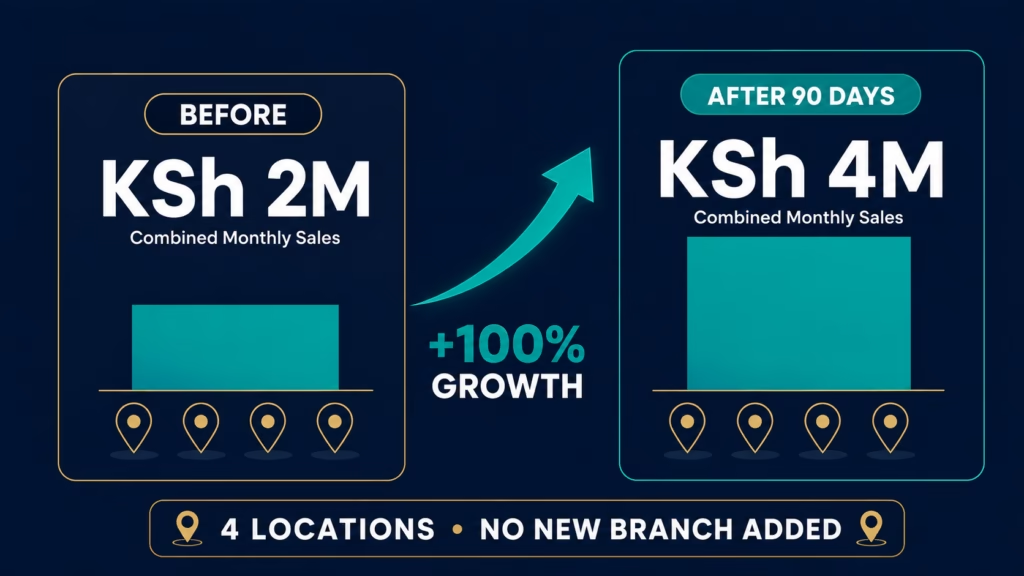
Over a 90-day period, we aligned its digital marketing, branch operations and customer experience around one commercial goal. By the end of the third month, combined monthly sales across the four locations had reached KSh 4 million.
That represented:
- KSh 2 million in additional monthly sales
- 100% growth from the baseline monthly figure
- An average increase from approximately KSh 500,000 to KSh 1 million per location, when viewed evenly across four branches
- A three-month implementation period
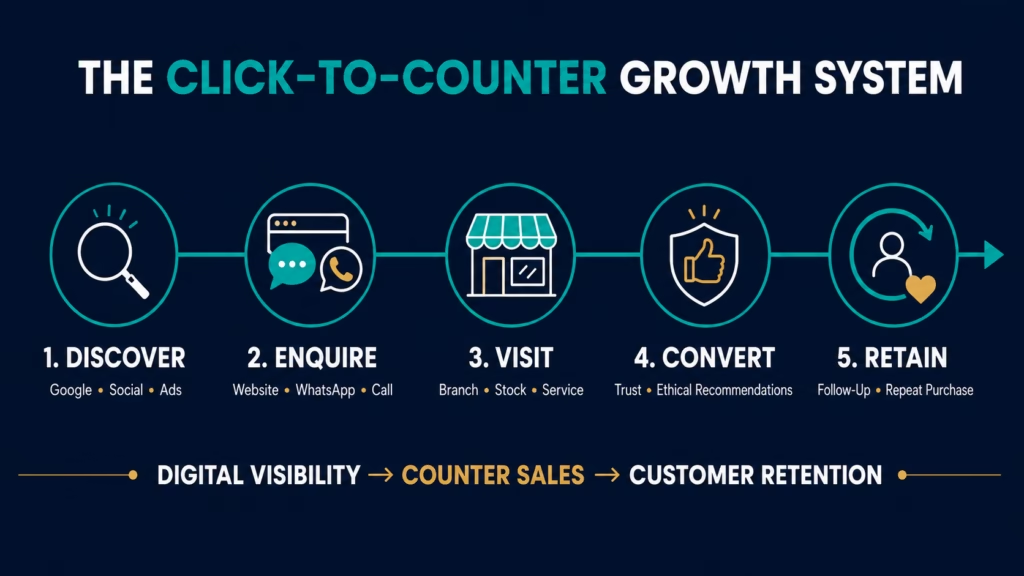
The growth was not produced by one advertisement, one platform or one promotion. It came from connecting the full customer journey, from digital discovery to the pharmacy counter and the repeat purchase.
Confidentiality note: The pharmacy’s identity and commercially sensitive information have been withheld. The sales figures in this case study represent combined monthly sales across its four locations. No individual patient or customer information is included.
Executive summary
| Measure | Before implementation | By the end of month three | Change |
|---|---|---|---|
| Combined monthly sales | KSh 2,000,000 | KSh 4,000,000 | +KSh 2,000,000 |
| Percentage increase | — | — | 100% |
| Number of locations | 4 | 4 | No additional branch required |
| Implementation period | — | 90 days | 3 months |
The work focused on five connected areas:
- Diagnosing the real sales and marketing gaps
- Improving local digital visibility
- Creating clearer customer-acquisition campaigns
- Aligning branch teams and inventory with marketing activity
- Building a more consistent customer journey from enquiry to purchase
The challenge: Visibility and Sales were Disconnected
The pharmacy chain already had four physical locations and an existing customer base. The problem was not a complete lack of demand.
The larger issue was fragmentation.
Marketing activity, branch operations and frontline selling were not working as one system. A customer could see a promotion online but encounter a different experience at the branch. Staff did not always have enough context about current campaigns. Digital enquiries were not consistently followed through to purchase. The business also lacked a simple way to connect marketing activity with what was happening at the counter.
This created several common revenue leaks:
- Potential customers could not always find complete and consistent information online.
- Marketing messages were not sufficiently connected to specific customer needs.
- Online enquiries did not always receive a fast, structured response.
- Branch staff were not consistently prepared for advertised products and promotions.
- Product availability and marketing priorities were not always aligned.
- The counter experience varied between locations.
- There was limited follow-up designed to encourage repeat business.
Running more advertisements without fixing these gaps would simply have sent more people into an inconsistent customer journey.
The diagnosis: This was not only a Marketing Problem
Before making major changes, I examined the journey a customer followed:
- How did the customer discover the pharmacy?
- What information did they see before making contact?
- What happened when they called, sent a message or visited a branch?
- Could the team identify the customer’s actual need?
- Was the relevant product available?
- Did the interaction build enough trust to secure the purchase?
- Was there a reason or system for the customer to return?
The audit showed that digital marketing could not be treated as a separate department that ended when an advert received a click.
The complete growth system needed to connect three areas:
- Customer acquisition: attracting people through search, social media, advertising and local visibility
- Counter conversion: ensuring staff, stock and service were prepared when the customer arrived
- Customer retention: creating a reliable experience that encouraged repeat purchases and referrals
That diagnosis became the basis of the 90-day plan.
The 90-day Pharmacy Growth Strategy
Pillar 1: Strengthening Digital Visibility
The first priority was making it easier for nearby customers to discover and contact the pharmacy.
The work included improving the pharmacy’s digital presence and ensuring that important customer information was clearer and more consistent. Particular attention was given to location-based visibility because customers searching for a pharmacy often have immediate intent.
The digital foundation focused on:
- Clear and consistent branch information
- Accurate contact and operating details
- Better presentation of products and services
- Stronger local search visibility
- Clear paths from online discovery to calls, messages, directions and visits
- Content that answered real customer questions rather than simply announcing products
The objective was not visibility for its own sake. Every digital touchpoint needed to help the customer take a meaningful next step.
Pillar 2: Creating Focused Digital Campaigns
The second priority was replacing scattered promotional activity with campaigns built around clearer customer needs and actions.
Rather than treating everyone as one large audience, campaign messages were aligned with relevant customer groups, locations and purchase intentions. Creative content focused on usefulness, accessibility, trust and convenience.
The campaign approach included:
- Clear objectives for each campaign
- Location-relevant messaging
- Stronger calls to action
- A mix of educational and promotional content
- Consistent pathways to WhatsApp, phone enquiries or store visits
- Regular review of campaign performance and customer response
The aim was to attract more relevant customers—not merely accumulate views, likes or clicks.
Pillar 3: Connecting Marketing with Stock and Branch Readiness
Advertising a product that is unavailable damages trust and wastes marketing spend.
For that reason, promotions needed to be coordinated with product availability and branch readiness. Teams needed to know what was being promoted, why it mattered to the customer and how to handle related enquiries.
This required closer alignment between:
- Marketing priorities
- Available inventory
- Branch-level demand
- Staff product knowledge
- Customer questions and feedback
This operational alignment helped ensure that digital demand could be served when it reached the business.
Pillar 4: Improving the Counter Conversation
The pharmacy counter was treated as a conversion point not merely a place where products were handed over.
The focus was on helping staff conduct more useful, ethical and customer-centred conversations. This did not mean pressuring customers or recommending unnecessary products. It meant listening carefully, asking appropriate questions within professional boundaries and providing clear guidance.
The counter-sales approach emphasised:
- Understanding the customer’s immediate need
- Communicating clearly and respectfully
- Offering relevant information rather than overwhelming the customer
- Making appropriate complementary recommendations where justified
- Avoiding aggressive or unsuitable upselling
- Creating a consistent service experience across the four locations
Better marketing attracts attention. Better conversations convert that attention into trust and revenue.
Pillar 5: Building Retention into the Customer Journey
Acquiring a customer once is more expensive than giving a satisfied customer a reason to return.
The growth strategy therefore extended beyond the first transaction. Customer service, response speed, reliable product availability and follow-up were treated as part of marketing—not separate from it.
Retention efforts focused on:
- Faster handling of enquiries
- More consistent service across branches
- Better continuity between online conversations and in-store visits
- Appropriate follow-up and reminders
- Encouraging customer feedback
- Using recurring questions to improve future content and offers
The goal was to build a repeatable customer journey, not depend on isolated promotions.
How the implementation unfolded
Month one: Diagnose and Rebuild the Foundation
The first month concentrated on identifying revenue leaks and correcting the foundation.
Key priorities included reviewing digital touchpoints, clarifying customer pathways, aligning branch information and identifying gaps between marketing activity and frontline execution.
The most important outcome of this phase was shared understanding: marketing, stock, staff readiness and customer service had to support the same commercial objective.
Month Two: Activate and Coordinate
During the second month, the pharmacy implemented more focused campaigns and strengthened coordination between digital activity and the branches.
Customer responses, enquiries and branch feedback were used to refine messages and priorities. The business paid closer attention to what customers were asking for and whether each branch was prepared to fulfil that demand.
Month Three: Optimize what was Working
The third month focused on reinforcing effective activities, correcting weak points and improving consistency.
Rather than continuously introducing new tactics, the business concentrated on the customer journeys and messages producing the strongest commercial response. This disciplined optimisation helped turn early improvements into a stronger monthly result.
The Result: Monthly Sales Grew from KSh 2 Million to KSh 4 Million
By the end of the three-month implementation period, combined monthly sales across the four locations had increased from approximately KSh 2 million to KSh 4 million.
This was a 100% increase in the monthly sales figure without adding another location.
The result demonstrated an important principle: digital marketing performs better when the business behind the campaign is prepared to convert and retain the demand being generated.
The sales increase should not be attributed to a single channel in isolation. It reflected the combined effect of stronger visibility, clearer campaigns, better operational alignment, improved customer handling and a more consistent focus on retention.
Why The Strategy Worked
1. We Focused on Revenue, not Vanity Metrics
Reach, impressions and clicks were useful indicators, but they were not the final measure of success. The commercial objective remained sales growth across the four branches.
2. Marketing and Operations Worked Together
The pharmacy did not treat digital marketing as an isolated online activity. Campaigns, stock, staff readiness and the branch experience were brought into closer alignment.
3. The Complete Customer Journey was Addressed
The strategy considered what happened before, during and after the sale. This reduced the risk of attracting customers only to lose them through poor execution.
4. The Approach was Customer-Centred
Messages and counter conversations focused on solving relevant customer problems and building trust. This was more sustainable than relying entirely on discounts.
5. The Business Improved Through Consistent Execution
The outcome did not come from a secret tactic. It came from repeatedly doing the essential things better: being visible, responding clearly, preparing the branches, serving customers well and learning from the results.
Important Context and Limitations
This case study reports the change in combined monthly sales from the baseline figure to the figure achieved by the end of month three. It does not claim that every additional shilling can be attributed to one advertisement or platform.
Pharmacy performance can also be influenced by product availability, seasonality, pricing, location, staff execution and existing customer demand. For that reason, the result is presented as the outcome of an integrated digital and operational growth programme.
Results will vary between businesses. The purpose of this case study is to demonstrate the strategy and execution principles used—not to guarantee that every pharmacy will achieve identical growth.
Lessons for Pharmacy Owners and Healthcare Retailers
This project produced several lessons that apply beyond one pharmacy chain:
- More advertising will not repair a broken customer journey. Fix the gaps between the advert, enquiry, branch visit and sale.
- Local visibility matters. Customers must be able to find accurate information and contact the correct branch easily.
- Promote what the business is prepared to fulfil. Marketing, stock and staff knowledge must be coordinated.
- Train frontline teams as part of the marketing strategy. The counter conversation can strengthen or destroy the trust created online.
- Measure commercial outcomes. Impressions and engagement matter, but revenue, enquiries, visits and repeat business provide stronger evidence.
- Retention deserves deliberate attention. Sustainable growth cannot depend entirely on continually acquiring new customers.
From Digital Visibility to Counter Sales
The central lesson from this engagement is simple:
Digital marketing brings the customer closer. The experience at the counter determines whether that attention becomes trust, a sale and a repeat customer.
This principle now forms the basis of my Click-to-Counter Growth System—an approach that connects digital discovery, customer acquisition, ethical frontline selling and retention.
I work with pharmacies and healthcare businesses through:
- Digital growth consulting
- Pharmacy sales and customer-experience training
- SEO, local visibility and paid advertising strategy
- Conference speaking and corporate workshops
- Healthcare content and campaign development
If your pharmacy is generating attention but struggling to convert it into measurable growth, the answer may not be another disconnected campaign. It may be a better system connecting what happens online with what happens inside the business.
For speaking, training or pharmacy growth consulting, visit Neksas Digital or connect with Irene Wanyama on LinkedIn.
