

Google Maps has become the single most important discovery channel for local businesses in Kenya. When someone in Nairobi searches for “best plumber near me” or “restaurant in Westlands,” Google Maps is what they see first. Over 85% of local searches now show Maps results before anything else, and the businesses that appear in the top three positions of the Google Local Pack capture the vast majority of clicks, calls, and direction requests.
For Kenyan businesses, appearing in the Google Local Pack is not optional. It is the difference between being found by ready-to-buy customers and being invisible. Higher rankings on Google Maps lead directly to more phone calls, more website visits, more foot traffic, and more revenue. This guide covers the ten proven Google Maps SEO strategies that Kenyan businesses can implement right now to climb the rankings and stay there.
If you are looking for a comprehensive walkthrough on setting up your profile, read our Complete Google Business Profile Guide for Kenyan Businesses.
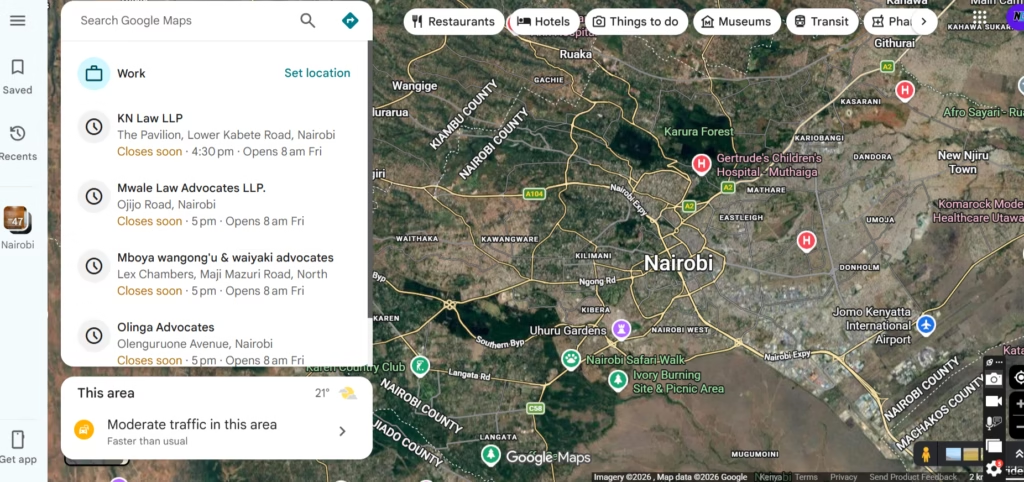
Why Google Maps Rankings Matter
More Visibility
The Google Local Pack appears above traditional organic search results. It is the first thing users see when they search with local intent. Businesses in positions one, two, and three get exponentially more impressions than those ranked fourth or lower. If you are not in the top three, most potential customers will never know you exist.
More Phone Calls
Google Maps listings include a prominent “Call” button. Users searching on mobile devices can tap once and dial your business directly. Data shows that businesses ranking in the top three positions receive significantly more click-to-call actions than lower-ranked competitors. In Kenya, where mobile search dominates, this single feature can transform your lead generation.
More Website Visits
Your Google Business Profile includes a direct link to your website. Higher rankings mean more profile views, and more profile views mean more website traffic. This traffic is high-intent, meaning these visitors are actively looking for what you offer and are far more likely to convert into paying customers.
More Direction Requests
For brick-and-mortar businesses, the “Directions” button is a direct pipeline to foot traffic. When a user requests directions to your location, they have already decided to visit. Restaurants, retail stores, clinics, and service providers all benefit from increased direction requests driven by higher Maps rankings.
Higher Trust and Credibility
Appearing in the top three positions signals authority. Users trust Google’s algorithm to surface the best businesses. A top-ranked listing with strong reviews and complete information builds instant credibility before a customer ever speaks to you.
More Local Customers
Ultimately, every benefit above converges on one outcome: more local customers. Google Maps connects you with people in your immediate area who are actively searching for your products or services. No other marketing channel delivers this level of targeted, high-intent local traffic.
How Google Maps Rankings Work
What Is the Google Local Pack?
The Google Local Pack is the map-based listing that appears at the top of Google’s search results for queries with local intent. It typically displays three business listings alongside a map showing their locations. This is prime real estate. Studies consistently show that the Local Pack drives 70 to 80% of all local leads.
When a user searches for “pharmacy in Mombasa” or “digital marketing agency Nairobi,” the Local Pack is what they interact with first. Winning a position in this pack means winning the attention of customers who are ready to take action.
Understanding Google’s Local Search Algorithm
Google’s local search algorithm has evolved significantly. In 2026, it is no longer just about proximity and keywords. Google’s AI now evaluates businesses as entities, analyzing engagement patterns, review sentiment, content freshness, and real-world trust signals. The March 2026 Core Update pushed AI Overviews deeper into local search, and 46% of all Google searches now carry local intent.
This means your Google Business Profile is not just a directory listing. It is a dynamic asset that Google monitors continuously for signals of activity, relevance, and authority.
The Three Main Ranking Factors
Google evaluates every local business through three core pillars before deciding who appears in the Local Pack:
Relevance measures how well your business profile matches what the user searched for. Your primary category, service descriptions, business name, and the content of your Google Posts all feed this signal. A business that lists specific services like “emergency drain unblocking” will outrank a generic “plumbing company” for that exact query.
Distance calculates how physically close your business is to the searcher. For “near me” queries, proximity carries significant weight. A business one mile away can outrank a larger competitor three miles out. However, distance alone never guarantees a top position.
Prominence measures how well-known and trusted your business is online and offline. This factor pulls from review volume and quality, backlink profile, citation consistency, Knowledge Graph recognition, and real-world brand signals. A local hardware store with 300 reviews and links from the Kenya National Chamber of Commerce will outrank a closer competitor with weak brand signals.
Google Maps Ranking Factor #1 – Optimize Your Google Business Profile
Your Google Business Profile is the single most important ranking factor, carrying approximately 32% of the total local ranking weight. A complete, active profile signals trust to Google faster than any other optimization. Most businesses lose Local Pack positions not because of weak backlinks, but because their profile sits half-finished.
Complete Every Section of Your Profile
Business Name: Your business name must match your real-world, registered business name exactly. Adding keywords to your name violates Google policy and risks suspension. If your legal name lacks descriptive keywords, compensate by excelling in every other optimization area.
Category: Your primary category is the strongest single relevance signal in your entire profile. Choose the most specific category available. “Pizza Restaurant” outperforms “Restaurant.” “Internet Marketing Service” outperforms “Marketing Agency.” Search your target keywords on Google Maps and check what primary category the top three results use. Match accordingly.
Description: Write a 750-character description that includes your core services and location naturally. In 2026, high-performing profiles use persuasive copy that addresses customer pain points and highlights unique selling points. Do not keyword stuff. Google reads your description for entity disambiguation and relevance matching.
Services: List every service individually rather than bundling them. Your service menu tells Google exactly what you offer and directly improves relevance matching for transactional queries. Use semantic, long-tail keywords in your service descriptions.
Products: If you sell products, add them to your profile with accurate descriptions, pricing, and images. Product catalogs keep users on your profile longer and provide additional relevance signals.
Hours: Keep your business hours accurate and updated, including holiday hours. Google tracks how often users visit your profile and find you closed. Inaccurate hours hurt both user experience and rankings.
Contact Information: Ensure your phone number, website URL, and email are correct and consistent across every platform.
Add a High-Quality Business Logo
Upload a clear, professional logo that represents your brand. This appears in your listing and builds recognition. Use a high-resolution image with a minimum size of 720×720 pixels.
Upload a Professional Cover Photo
Your cover photo is the first visual impression users get. Choose an image that showcases your business environment, team, or best-selling product. Avoid stock photos. Authentic imagery performs better.
Add New Photos Regularly
Photos remain one of the strongest local ranking factors. Add new, authentic images weekly to showcase your team, products, workspace, and community involvement. Use clear filenames that include entity-rich descriptors, such as “mombasa-pharmacy-interior-2026.jpg.” Recommended resolution is 720×720 minimum for photos and 720p for videos.
For a detailed checklist on profile optimization, see our [Google Business Profile Optimization Checklist].
Google Maps Ranking Factor #2 – Choose the Right Business Categories
Why Categories Matter
Your primary category determines which searches you appear for, how competitive your listing is, and your overall relevance score. According to Whitespark’s 2026 Local Search Ranking Factors survey, primary category selection carries a score of 193, making it the single most influential local pack signal. Getting it wrong is equally damaging, with incorrect primary category scoring 176 as a negative factor.
Primary Category Best Practices
Select the most precise primary category that matches your core business activity. If you run a dental clinic, choose “Dental Clinic” not “Health Consultant.” If you operate a hardware store, choose “Hardware Store” not “Retail Business.” Analyze the top five competitors ranking above you for your target keywords and note their primary categories. Only match their category if it truly applies to your business.
Secondary Categories
Add all relevant secondary categories to increase your reach for additional keywords. Secondary categories expand the range of queries your business can appear for without diluting your primary focus. A restaurant might add “Cafe,” “Bar,” and “Breakfast Restaurant” as secondary categories.
Common Category Mistakes
The most common mistake is selecting a category that is too broad or misleading. Another error is changing categories frequently in an attempt to game the algorithm. This confuses Google’s entity recognition and can trigger ranking volatility. Choose your categories carefully, monitor performance, and make changes only when necessary.
For more details, read [Google Business Profile Categories Explained].
Google Maps Ranking Factor #3 – Get More Google Reviews
Why Reviews Influence Rankings
Reviews now represent 16% of the overall ranking weight in Google’s local algorithm. But it is not just about star ratings. Google’s AI reads the actual words in reviews to understand sentiment and context. When a customer writes, “The gluten-free pizza was the best I have ever had,” Google’s AI connects your business to “gluten-free pizza” searches. This allows you to rank for specific, long-tail keywords that your customers provide.
Review velocity, the consistency with which new reviews arrive, matters as much as total count. A steady trickle of five reviews per week beats a burst of fifty reviews in one day followed by weeks of silence. Google interprets consistent review flow as a sign of a healthy, active business.
How Many Reviews Do You Need?
Top three positions in the Local Pack average over 200 reviews. Positions four through ten average 185 reviews, and positions eleven through twenty average 140 reviews. In 2026, the AI citation threshold sits at 150 reviews per location. Below that number, platforms like ChatGPT, Perplexity, and Gemini rarely name your business in local recommendations.
How to Ask Customers for Reviews
WhatsApp Review Requests: Send a direct message to satisfied customers with a link to your Google review page. Keep the message short and personal. “Hi [Name], thank you for choosing [Business Name]. If you have a moment, we would really appreciate a quick review on Google. Here is the link: [URL].”
SMS Requests: Text messages have high open rates. Send a follow-up SMS within 24 hours of service completion with a direct review link.
Email Requests: For B2B clients or customers who provided email addresses, send a polite follow-up email three to five days after service. Include the direct review link and explain how their feedback helps other customers.
QR Code Requests: Print QR codes on receipts, business cards, or in-store displays. Customers scan the code and land directly on your review page. This works exceptionally well for restaurants, retail stores, and clinics.
How to Respond to Reviews
Positive Reviews: Respond to every positive review within 24 to 48 hours. Thank the customer by name, reference specific details from their review, and include a local reference or service mention when appropriate. Detailed replies reinforce relevance and show Google that your profile is actively managed.
Negative Reviews: Respond professionally and promptly. Acknowledge the issue, apologize sincerely, and offer a solution or invitation to discuss offline. Never argue with a reviewer publicly. A well-handled negative review can actually improve trust signals.
For a complete review generation strategy, see [How to Get More Google Reviews].
Google Maps Ranking Factor #4 – Maintain NAP Consistency
What Is NAP?
NAP stands for Name, Address, and Phone Number. These three pieces of information form the foundation of your business identity across the web.
Name: Your registered business name, exactly as it appears on official documents and signage.
Address: Your complete physical address, formatted consistently everywhere.
Phone Number: Your primary business phone number, including country code for Kenyan businesses (+254).
Why NAP Consistency Matters
Google evaluates your business as an entity, not just a listing. When your NAP information varies across directories, social platforms, and your website, Google encounters conflicting signals. A single address or phone number variation across directories triggers entity fragmentation. Google stops trusting your business data, and your Local Pack visibility drops directly as a result.
Inconsistent NAP data confuses both Google’s algorithm and potential customers. If one directory lists your old phone number and another lists a different address, users may call the wrong number or visit the wrong location.
Common NAP Errors
Common errors include abbreviating “Street” as “St.” on some platforms but not others, using different phone number formats, listing a P.O. Box on some sites and a physical address on others, and using nicknames or variations of your business name. Even minor mismatches reduce trust and visibility.
How to Fix Inconsistent Business Information
Conduct a full audit of every platform where your business appears. This includes your website, Google Business Profile, Facebook, LinkedIn, Yelp, Yellow Pages Kenya, and any industry-specific directories. Standardize your NAP format and update every listing to match exactly. Use a spreadsheet to track every citation and monitor for new inconsistencies quarterly.
Google Maps Ranking Factor #5 – Add Services and Products
Why Services Matter
Your service menu tells Google exactly what you offer and directly improves relevance matching for transactional local intent queries. A plumber listing “emergency drain unblocking,” “pipe repair,” and “bathroom installation” will rank for those specific services far better than a competitor with a generic “plumbing services” entry.
Why Products Matter
Product listings keep users engaged on your profile longer, provide additional relevance signals, and can drive direct conversions. For retail businesses, product catalogs allow customers to browse inventory before visiting your store.
Examples for Kenyan Businesses
Pharmacies: List specific product categories like “prescription medication,” “over-the-counter drugs,” “baby care products,” “vitamins and supplements,” and “medical equipment.”
Restaurants: Add your full menu as product listings with descriptions and prices. Include categories like “breakfast menu,” “lunch specials,” “vegetarian options,” and “traditional Kenyan dishes.”
Agencies: List services like “SEO services,” “social media management,” “web design,” “PPC advertising,” and “content marketing” with detailed descriptions of what each service includes.
Hardware Stores: Add product categories like “building materials,” “electrical supplies,” “plumbing fixtures,” “paint and finishes,” and “tools and equipment.”
Beauty Businesses: List services like “hair styling,” “nail art,” “facial treatments,” “massage therapy,” and “bridal makeup packages” with pricing and duration.
Google Maps Ranking Factor #6 – Publish Google Business Profile Posts
What Are Google Posts?
Google Posts are short updates that appear directly on your Google Business Profile. They function like mini-ads, allowing you to share offers, events, updates, and product announcements with people who find your listing. Posts create immediate, measurable signals of activity and provide content that Google’s AI can use for rich previews and AI Overviews.
Types of Google Posts
Offers: Promote discounts, limited-time deals, or special packages. Include a clear call to action and expiration date.
Events: Announce upcoming events, workshops, or special occasions. Include the date, time, and location.
Updates: Share general news about your business, such as new hours, new team members, or expanded services.
Product Announcements: Highlight new products or services with images, descriptions, and pricing.
Posting Frequency Recommendations
In competitive markets, post a minimum of two times per week. Add at least one new photo monthly. Consistency matters more than volume because Google tracks posting frequency as part of profile completeness scoring. A local HVAC company tracked by researchers went from position six to position three in sixty days by posting twice weekly with service updates and adding four new job-site photos per month. No other changes were made. GBP Posts and photo cadence alone moved the needle.
Content Ideas for Kenyan Businesses
Share behind-the-scenes photos of your team at work. Post about community events you are participating in. Announce new product arrivals or menu items. Share customer testimonials with permission. Post seasonal offers tied to Kenyan holidays or events. Update followers on business hour changes during public holidays. Highlight safety measures or certifications. Feature employee spotlights to humanize your brand.
Google Maps Ranking Factor #7 – Build Local Citations
What Are Local Citations?
A local citation is any online mention of your business name, address, and phone number. Citations appear on business directories, industry-specific platforms, social media profiles, and local news sites. They validate your business existence and help Google confirm that you are a legitimate, established entity.
Why Citations Matter
Citations carry approximately 7% of the total local ranking weight. While this is a smaller percentage than GBP signals or reviews, citations remain essential for entity trust. Google cross-references your NAP information across multiple sources to verify accuracy. Consistent citations strengthen your prominence and help Google understand your business identity.
Popular Citation Sources in Kenya
Business Directories: Yellow Pages Kenya, BusinessList.co.ke, Kenya Business Directory, and similar platforms provide foundational citation opportunities.
Industry Directories: Depending on your sector, list your business on relevant industry platforms. Medical practices should appear on health directories. Legal firms should be listed on legal association sites. Restaurants should appear on food and dining platforms.
Chamber of Commerce Listings: Membership in the Kenya National Chamber of Commerce and Industry or local county chambers provides high-authority citations and networking opportunities.
Avoid spammy mass submissions. Google’s AI devalues low-quality directory links instantly. Focus on authoritative, relevant sources.
Google Maps Ranking Factor #8 – Improve Your Website’s Local SEO
Why Your Website Affects Maps Rankings
Your website directly influences your Google Maps authority. Google evaluates on-page signals as part of the local ranking algorithm, and these signals carry approximately 19% of the total weight. A well-optimized website reinforces the information in your Google Business Profile and provides additional relevance and trust signals.
Add Location Pages
If you serve multiple areas, create dedicated location pages for each city or neighborhood. Each page must include the city and service in the URL, title tag, and H1 heading. Embed a Google Map showing your location, add LocalBusiness schema markup, include local FAQs, and feature testimonials from customers in that area. Mention nearby landmarks and neighborhoods to boost hyperlocal relevance.
Optimize Title Tags
Include your primary keyword and location in every title tag. For example, “Best Dental Clinic in Nairobi | [Business Name]” or “Affordable Web Design Services in Mombasa | [Business Name].” Keep title tags under 60 characters to ensure they display fully in search results.
Use Local Keywords
Incorporate location-specific keywords naturally throughout your website content. Use terms like “pharmacy in Westlands,” “plumber near Kilimani,” or “digital marketing agency in Kenya.” Include these in headers, body text, image alt text, and meta descriptions.
Improve Website Speed
Page speed is a confirmed ranking factor for both organic and local search. Use tools like Google PageSpeed Insights to identify issues. Compress images, enable browser caching, minimize JavaScript, and use a reliable hosting provider. Slow websites frustrate users and signal poor quality to Google.
Mobile Optimization
Over 80% of local searches in Kenya happen on mobile devices. Your website must be fully responsive, with clickable phone numbers, easy-to-use navigation, and fast-loading pages on mobile networks. Google uses mobile-first indexing, meaning your mobile site is what gets evaluated for rankings.
Google Maps Ranking Factor #9 – Earn Local Backlinks
What Are Backlinks?
A backlink is a link from another website to your website. Backlinks act as votes of confidence. When a reputable site links to you, Google interprets this as a signal that your business is trustworthy and authoritative.
Why Local Backlinks Matter
Backlinks carry approximately 15% of the total local ranking weight. However, local relevance matters more than raw quantity. One strong local backlink from a Kenyan news site or industry association can outperform fifty generic links from irrelevant directories.
Backlink Opportunities in Kenya
Local News Sites: Pitch story ideas to Kenyan news outlets and blogs. Local features, community involvement, or business milestones can generate coverage and valuable backlinks.
Industry Associations: Join relevant professional associations in Kenya. Most association websites include member directories with links to member websites.
Business Partnerships: Partner with complementary businesses and request cross-promotion or guest content exchanges. A wedding photographer might partner with a venue, or a web designer might partner with a digital marketing agency.
Sponsorships: Sponsor local events, sports teams, or community initiatives. Sponsorship pages typically include a link back to your website. Choose sponsorships that align with your brand and target audience.
Google Maps Ranking Factor #10 – Keep Your Profile Active
Regular Updates
An active profile signals to Google that your business is operational and engaged. Update your profile whenever something changes. Add new services, adjust hours for holidays, update contact information, and refresh your description periodically. Stagnant profiles slowly lose rankings even if they once ranked number one.
New Photos
Upload new photos at least once per month. Show your current team, recent projects, seasonal offerings, and updated interior or exterior shots. Fresh visual content keeps your profile engaging and signals activity to Google’s algorithm.
Review Responses
Continue responding to all new reviews promptly. Ongoing review management shows Google and potential customers that you value feedback. Set up notifications so you never miss a new review.
Updated Services
As your business evolves, update your service menu. Add new offerings, remove discontinued services, and refresh descriptions to reflect current capabilities.
Updated Business Hours
Always update your hours for public holidays, Ramadan, special events, or temporary closures. Nothing frustrates a customer more than arriving at a business that Google says is open but is actually closed.
Common Reasons Your Business Isn’t Ranking on Google Maps
Unverified Profile
If you have not claimed and verified your Google Business Profile, you will not rank. Verification is the absolute minimum requirement. Google rewards verified businesses with greater visibility and access to advanced features.
Wrong Categories
An incorrect primary category is one of the fastest ways to sabotage your rankings. If you chose a category that does not accurately reflect your core business, Google will not match you with relevant searches.
Few Reviews
Businesses with fewer than fifty reviews struggle to compete in most markets. If your competitors have hundreds of reviews and you have ten, Google will favor them regardless of other optimizations.
Incomplete Profile
Leaving sections of your Google Business Profile blank weakens your profile completeness score and drops your Local Pack visibility. Every empty field is a missed opportunity to signal relevance.
Inconsistent Information
NAP inconsistencies across the web fragment your entity and reduce Google’s trust in your business data. Audit every citation and ensure perfect consistency.
Suspended Listing
If your listing violates Google’s guidelines, it may be suspended. Common causes include keyword stuffing in your business name, using a virtual office address, or creating multiple listings for the same location. If your listing is suspended, you lose all visibility immediately.
For help with suspended listings, read [Why Your Google Business Profile Was Suspended].
Google Maps SEO Checklist
Complete Profile
Fill out every section of your Google Business Profile. Business name, category, description, services, products, hours, contact information, attributes, and Q&A should all be complete and accurate.
Correct Categories
Choose the most precise primary category available. Add all relevant secondary categories. Audit competitor categories and align with best practices.
Regular Reviews
Implement a systematic review request process. Aim for a steady flow of new reviews every week. Respond to all reviews within 24 to 48 hours.
Quality Photos
Upload a professional logo and cover photo. Add new authentic photos at least monthly. Use clear, descriptive filenames and high resolution.
Active Posting
Publish Google Posts at least once per week, twice in competitive markets. Mix offer, event, update, and product announcement posts.
Local Citations
Build citations on authoritative Kenyan business directories, industry platforms, and chamber of commerce listings. Maintain perfect NAP consistency.
Local Backlinks
Earn links from Kenyan news sites, industry associations, business partners, and sponsorships. Prioritize local relevance over quantity.
Website Optimization
Add location pages for multi-area businesses. Optimize title tags and content with local keywords. Ensure fast loading speeds and full mobile responsiveness.
Case Study Example
How a Local Business Improved Visibility on Google Maps
Starting Situation: A dental clinic in Nairobi’s Westlands area was struggling to appear in the Local Pack for searches like “dentist in Westlands” and “teeth cleaning Nairobi.” The clinic had a verified Google Business Profile but had not optimized it beyond basic information. They had 12 reviews, no Google Posts, no service listings, and an outdated website. They were ranking in position 11 for most target queries.
Optimization Actions Taken: The clinic completed every section of their Google Business Profile, including a detailed 750-character description, a full service menu listing 14 specific dental services, and accurate business hours.
They changed their primary category from “Medical Clinic” to “Dental Clinic” and added “Cosmetic Dentist” and “Pediatric Dentist” as secondary categories. Also, implemented a review request system using WhatsApp and email follow-ups, increasing their review count from 12 to 187 over six months.
They began posting twice weekly on GBP, sharing dental care tips, patient success stories, and special offers. Then added location-specific pages to their website for Westlands, Parklands, and Kilimani, each with embedded maps and LocalBusiness schema.
They earned three local backlinks through a feature in a Nairobi lifestyle blog and membership in a dental association.
Results Achieved: Within four months, the clinic moved from position 11 to position 3 for “dentist in Westlands.” After six months, they achieved position 2 for “teeth cleaning Nairobi” and position 1 for “pediatric dentist Westlands.” Direction requests increased by 340%, phone calls from GBP rose by 280%, and new patient bookings attributed to Google Maps grew by 195%. The clinic now maintains an active posting schedule and continues generating reviews at a rate of four to five per week.
Frequently Asked Questions
How Long Does It Take to Rank Higher on Google Maps?
Most businesses see measurable improvements within 60 to 90 days of consistent optimization. Significant ranking jumps, especially into the top three positions, typically require three to six months of sustained effort. Factors like competition level, starting position, and market size influence the timeline. A business in a low-competition rural area may rank faster than one in central Nairobi.
Can I Rank Without a Website?
Yes, but it is significantly harder. Google can rank a Google Business Profile without an associated website, particularly in low-competition areas. However, a well-optimized website provides additional relevance signals, backlink opportunities, and content that strengthens your overall authority. For competitive markets in Kenya, a website is highly recommended.
How Important Are Reviews?
Reviews are critical. They represent 16% of the total local ranking weight and serve as a major trust signal for potential customers. Google’s AI analyzes review content for sentiment and keyword relevance. Businesses in the top three positions average over 200 reviews. If you do nothing else, prioritize generating a steady stream of authentic customer reviews.
How Often Should I Post Updates?
Post on your Google Business Profile at least once per week. In competitive markets like Nairobi or Mombasa, post twice per week. Consistency matters more than volume. A regular posting schedule signals activity and freshness to Google.
Can I Rank in Multiple Locations?
Yes, but each location needs its own verified Google Business Profile and optimized location page on your website. You cannot rank for “plumber in Mombasa” with a Nairobi address unless you have a legitimate physical presence in Mombasa. For service-area businesses, accurately define your service areas in your profile, but understand that proximity still influences rankings.
What If My Competitors Have More Reviews?
Focus on review velocity and quality rather than just catching up on total count. A steady flow of new, detailed reviews can outrank a competitor with older, stagnant reviews. Encourage customers to mention specific services and locations in their reviews. Respond to every review professionally. Over time, consistent effort closes the gap.
Need Help Ranking Higher on Google Maps?
Improving your Google Maps rankings requires time, expertise, and consistent execution. Neksas Digital specializes in helping Kenyan businesses dominate local search through comprehensive Google Business Profile optimization, strategic review generation, citation building, and ongoing profile management.
We handle the technical work so you can focus on running your business. Our services include:
- GBP Optimization: Complete profile setup, optimization, and ongoing management.
- Google Maps SEO: Strategic improvements to boost your Local Pack rankings.
- Local SEO: Website optimization, local content creation, and technical SEO.
- Review Generation Strategies: Systematic processes to generate authentic reviews at scale.
- Citation Building: Consistent, high-quality citations across authoritative directories.
- Ongoing Profile Management: Regular posting, photo updates, review responses, and performance monitoring.
Ready to get more visibility, more calls, and more customers?
📲 WhatsApp: https://wa.me/254786877408
Conclusion
Ranking higher on Google Maps in Kenya comes down to ten core factors: optimizing your Google Business Profile completely, choosing precise categories, generating consistent reviews, maintaining NAP consistency, adding detailed services and products, publishing regular Google Posts, building local citations, improving your website’s local SEO, earning local backlinks, and keeping your profile active.
None of these are one-time tasks. Local SEO is an ongoing process. Google rewards businesses that demonstrate real-world activity, engagement, and trust. The businesses that treat Google Maps optimization as a continuous strategy, not a checklist, are the ones that dominate the Local Pack long-term.
Start with your Google Business Profile. Audit every field, fix inconsistencies, implement a review request system, and commit to posting weekly. Then layer in website optimization, citation building, and backlink outreach. Track your results, adjust your approach, and stay consistent.
For more local SEO guidance, explore our related articles:
- [Complete Google Business Profile Guide for Kenyan Businesses]
- [How to Create a Google Business Profile in Kenya]
- [How to Verify a Google Business Profile in Kenya]
- [Google Business Profile Optimization Checklist]
- [How to Get More Google Reviews]
- [Google Business Profile Categories Explained]
- [Why Your Google Business Profile Was Suspended]
Take action today. Your next customer is already searching on Google Maps.
