

A practical guide for healthtech and virtual-care leaders

A Working Platform Is Not the Same as an Adopted Service
Healthtech companies devote enormous attention to video quality, integrations, security and product features. Those capabilities matter. A virtual-care platform must be reliable, clinically appropriate and capable of protecting sensitive information. But a technically strong product can still struggle to attract and retain patients.
A patient may own a smartphone, have internet access and be eligible for a virtual appointment – yet still choose not to use telehealth. They may not understand when virtual care is appropriate. They may doubt that a clinician can assess them properly on screen, worry about privacy, abandon a complicated registration process or simply prefer a familiar in-person visit.
Access is not adoption. Registration is not activation. One completed video visit does not guarantee continued use.
Telehealth adoption depends on whether patients understand the service, trust it, can use it confidently and believe it fits their particular care needs. Improving adoption therefore requires more than adding features. It requires product, clinical, marketing and support teams to design one coherent patient journey.
This guide examines the barriers affecting patient adoption of telehealth and shows how healthtech companies can improve activation, successful consultations and continued, clinically appropriate use.
What Does Patient Adoption Mean in Telehealth?
Telehealth adoption is the process through which patients become aware of virtual care, understand its relevance, trust the service, successfully use it and continue choosing it when clinically appropriate. It is not a single event and cannot be measured accurately through downloads or account registrations alone.
Access Is Only the First Requirement
A patient may have a compatible device, internet connection, insurance coverage, an eligible health need and an available clinician. Those conditions create an opportunity to use telehealth, but they do not establish willingness, confidence or successful use. Access is necessary; it is not sufficient.
Registration Is Not Adoption
A meaningful adoption journey includes awareness, perceived relevance, account creation, appointment booking, technical readiness, attendance, a successful consultation, follow-up and continued use. A patient who creates an account but never books has not received care. A patient who books but cannot connect has been activated administratively, not clinically.
| Adoption journey: Awareness -> perceived relevance -> trust -> activation -> completed visit -> follow-up -> continued appropriate use. |
Adoption Should Not Mean Forcing Every Visit Online
More telehealth use is not automatically better care. Some symptoms require physical examination, diagnostic testing or urgent in-person assessment. Meaningful adoption allows patients and providers to select virtual care when it is suitable and move into in-person care without losing information or continuity.
Why a Technology-First Telehealth Strategy Falls Short
A platform can offer secure video, electronic health record integration, automated reminders, online payments and a long list of clinical features while adoption remains weak. Patients may not know the service exists, understand its purpose, trust the quality of care or complete onboarding. They may also be willing to use it but never hear a trusted clinician recommend it.
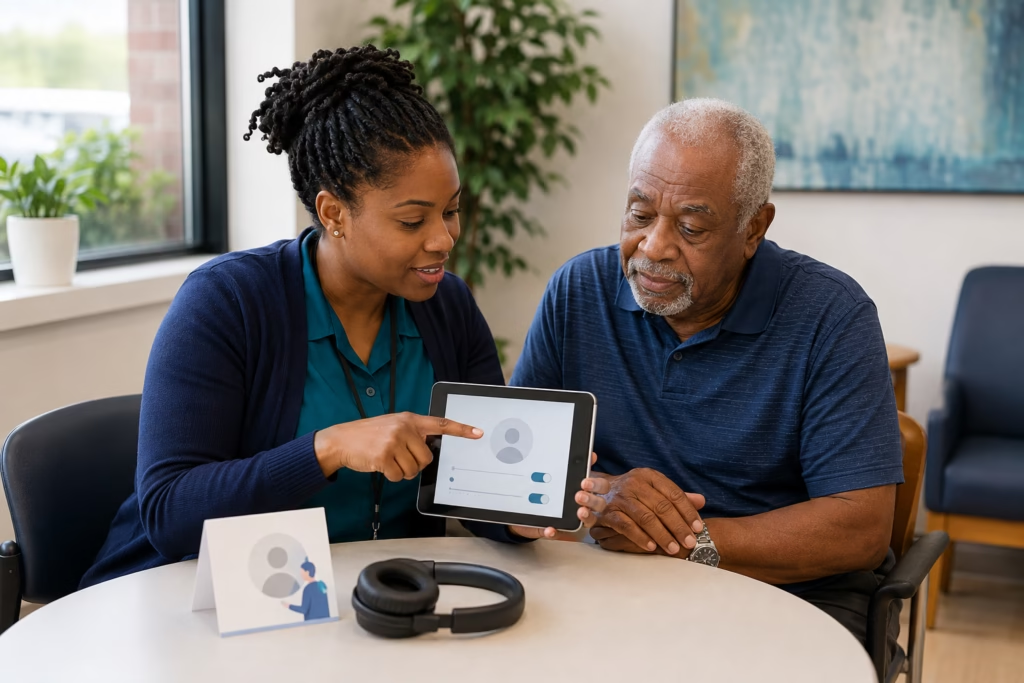
Patients Experience a Care Service – Not a Software Product
Product teams see workflows and functionality. Patients see a health decision. They want to know whether a competent clinician will listen, whether their information is safe, whether the process will save time and what will happen if the technology or virtual assessment is insufficient.
The video interface is only one part of that experience. Scheduling, payment, consent, technical preparation, clinician interaction, prescriptions, referrals and follow-up all influence whether the patient regards telehealth as useful and trustworthy.
Adoption Failure Is Rarely Caused by One Barrier
A 2025 scoping review identified recurring problems including not knowing how to use telehealth, not wanting to use it, lacking access to technology, technical failure and concern about care quality. It also found that patients commonly reported more than one barrier. Read the JAMIA Open review.
This matters because isolated solutions can miss the real problem. Providing a device will not solve distrust. Simplifying a form will not solve a provider’s failure to introduce telehealth. Improving video quality will not help a patient who lacks privacy at home.
8 Barriers Preventing Patients From Adopting Telehealth
1. Patients Do Not Understand When Telehealth Is Appropriate
Awareness is not the same as understanding. A message such as ‘see a doctor online’ tells patients that the service exists but not whether it is suitable for their situation. Some people assume virtual care is only for emergencies; others may expect it to replace every in-person visit.
Clear communication should show appropriate use cases, possible exclusions and the pathway to in-person care. Examples might include discussing test results, completing certain follow-ups, receiving behavioural-health support or deciding whether an in-person assessment is necessary. The aim is not to persuade every patient to choose telehealth. It is to help the right patient recognize the right moment to use it.
2. Patients Question the Quality of Virtual Care
Patients may wonder whether a clinician can diagnose accurately without a physical examination, whether the appointment will feel rushed or whether the provider will have access to relevant records. These concerns are not irrational objections; they are questions about clinical safety and the quality of the relationship.
Generic promises of ‘quality care from anywhere’ are not enough. Patients need specific explanations: who provides the care, which conditions can be assessed virtually, what happens when an examination is necessary and how prescriptions, referrals and follow-up are coordinated.
Concern about care quality appears among the most common patient-reported barriers in recent telehealth research. Review the evidence in JAMIA Open.
3. The Onboarding Process Creates Unnecessary Work
Patients can lose momentum before they ever meet a clinician. Repeated forms, complex passwords, unclear identity verification, app downloads, insurance uncertainty and multiple systems for booking, payment and consultation can turn a convenient service into another administrative burden.
Each requirement may appear reasonable when reviewed separately. The problem becomes visible only when the complete journey is observed from the patient’s perspective. Product teams should measure time to first successful visit, not merely account creation, and identify the exact step where eligible patients leave.
4. Digital Literacy and Confidence Are Mistaken for Access
Owning a smartphone does not mean a patient can confidently install an application, recover a password, enable camera access, upload documents, navigate a portal or troubleshoot audio. Health-related stress can make unfamiliar tasks even harder.
HHS notes that some patients benefit from basic digital-skills education and dedicated time with staff to learn how to use telehealth technologies confidently. See HHS educational and training standards.
Healthtech companies should avoid labelling patients as resistant when confusing design or inadequate support may be responsible. Confidence grows through plain instructions, early device checks, visible assistance and successful experience.
5. Access Barriers Extend Beyond Internet Availability
A patient can be technically connected and still lack practical access. Data may be expensive, the household may share one device, the phone may have limited storage or the patient may not have a private place for a consultation. Disability, limited English proficiency, unstable work schedules and dependence on a caregiver can create additional barriers.
CDC research among older Medicare beneficiaries found disparities in telehealth accessibility by income, location, sex and region. Internet access and previous experience with online voice or video calls were associated with greater access. Read the CDC study.
A video-only strategy can therefore exclude people who might benefit from remote care. Depending on clinical and regulatory requirements, services may need browser access, low-bandwidth modes, multilingual support, accessible interfaces, caregiver-assisted pathways or audio alternatives.
6. Privacy Assurances Are Too Vague to Build Trust
A statement that a service is compliant may satisfy a procurement checklist without answering a patient’s questions. Who can access the consultation? Is it recorded? How is personal information used? What happens on a shared device? How can the patient speak privately at home?
Trust is strengthened when privacy is explained in plain language throughout the journey. Consent should be visible, recording practices clear and support contacts easy to find. Appointment messages should use consistent branding so patients can distinguish legitimate communication from phishing. Practical guidance – such as using headphones or finding a private space – can be as important as legal language.
7. Providers Are Not Actively Introducing Telehealth
Patients are more likely to consider telehealth when a trusted clinician or staff member recommends it for a specific need. A clear explanation can answer the question that a landing page cannot: Why is virtual care appropriate for me this time?
AHRQ-supported research found that clinician interaction appeared to influence the adoption and use of consumer health technology positively. Read the AHRQ-supported research.
Marketing cannot compensate for providers who never mention the service, do not know which patients are eligible or do not trust the platform themselves. Provider adoption and patient adoption are connected.
8. The Service Does Not Fit the Patient’s Clinical or Everyday Reality

Telehealth can fail even when the patient likes the idea. The appointment may conflict with work, require privacy the home cannot provide, depend on equipment the patient does not own or exclude a caregiver who normally supports care. The condition itself may be too complex for a virtual pathway.
AHRQ-supported human-factors research found that poor fit between consumer-health applications, patients’ tasks and the home environment could contribute to non-use. Review the research.
Virtual care should therefore be designed as part of a care pathway, not as an isolated video appointment. The service must account for what happens before, during and after the consultation – including escalation to in-person care.
How Healthtech Companies Can Improve Telehealth Adoption
1. Map the Complete Patient-Adoption Funnel
Begin with every stage from eligibility to continued use. A practical funnel includes eligible population, awareness, interest, registration, booking, technical readiness, attendance, successful consultation, follow-up and repeat use.
The location of the drop-off changes the solution. Strong registrations but weak bookings may indicate unclear value, price or availability. Strong bookings but high no-shows may reveal reminder and preparation problems. Completed first visits followed by weak repeat use may point to clinical fit, experience or fragmented follow-up.
2. Research Non-Users – Not Only Satisfied Users
Active users can explain what works for them, but they cannot fully describe the barriers faced by people who never reached care. Research should include eligible patients who never registered, people who abandoned onboarding, patients who booked but did not attend and one-time users who returned to in-person care.
Caregivers, frontline support employees and clinicians with low telehealth utilization can reveal additional problems. Ask what patients expected, where they hesitated, what alternatives they chose and what would have made the service feel safer or easier.
3. Explain Telehealth Through Specific Patient Problems
Abstract messages such as ‘quality care anywhere’ sound attractive but require the patient to interpret when the service applies. Concrete use cases reduce uncertainty: discuss test results without travelling, complete an appropriate follow-up from home, access behavioural-health support or speak to a clinician about a minor concern.
Good communication also explains limitations. Patients should know when telehealth cannot provide the examination or intervention they need and what the escalation process will be.
4. Reduce the Effort Required Before the First Consultation
Review every step before the clinician appears. Remove duplicated fields, design forms for mobile screens, show progress, explain identity checks and provide price or insurance information early. Where practical, offer browser access, a recognizable appointment link, calendar integration, saved progress and straightforward password recovery.
Reducing friction does not mean weakening security or clinical safeguards. It means meeting those requirements with the least unnecessary effort and explaining why unavoidable steps exist.
5. Build Human Support Into the Product Experience
Patients may need a pre-visit test, phone support, live chat, staff-assisted registration or caregiver instructions. If video fails, there should be a rapid, clinically appropriate fallback rather than an abandoned appointment.
Support is not evidence that the product has failed. Healthcare services routinely combine people and systems. A digital navigator who helps a patient complete their first visit may create the confidence needed for independent future use.
6. Give Providers the Language and Confidence to Recommend It
Providers need eligibility criteria, clinical use cases, exclusions, escalation procedures, troubleshooting routes and clear information about documentation and follow-up. Short, patient-friendly explanations can help staff introduce virtual care consistently.
Do not ask clinicians to promote a service they cannot explain or trust. Involve them in workflow design, training and improvement so telehealth supports rather than disrupts care delivery.
7. Design for Multiple Levels of Access and Ability
Accessible telehealth design can include screen-reader compatibility, captions, keyboard navigation, plain language, multilingual instructions, low-bandwidth options, flexible scheduling and caregiver participation with appropriate consent. Hybrid pathways should allow patients to move to in-person care without starting over.
HHS recommends digital-literacy support and programs that improve access to technology and internet connectivity as part of preparing patients for hybrid care. Read the HHS guidance.
8. Make Trust Visible Throughout the Journey
Trust signals should not be confined to a privacy-policy link. Patients may need to see clinician credentials, clinical limitations, data practices, expected response times, pricing, support contacts and escalation procedures at different points in the journey.
Consistency matters. The service page, registration process, reminder messages, consultation interface and follow-up communication should feel like one credible care experience. Contradictory names, unfamiliar links or missing contact details create doubt at exactly the moment the patient is being asked to share sensitive information.
Measure Meaningful Telehealth Adoption – Not Vanity Metrics
Downloads and registrations are easy to count, but neither proves that a patient received care. Measurement should show how people progress through the adoption journey and whether the service produces a successful, equitable experience.
| Stage | Useful metric | A weak result may indicate |
| Awareness | Eligible patients who understand the service | Weak communication or limited provider introduction |
| Registration | Registration completion rate | Form, identity or password friction |
| Booking | Booking conversion and time to appointment | Unclear value, cost or availability |
| Readiness | Device-check completion | Late instructions or limited technical confidence |
| Attendance | Visit completion and no-show rate | Reminder, access or preparation problems |
| Experience | Ease, trust and support measures | Usability, reliability or care-quality concerns |
| Continued use | Appropriate repeat utilization and follow-up | Poor fit, weak outcomes or fragmented care |
Awareness and Activation Metrics
Track eligible patients reached, provider referral, service-page engagement, registration completion, booking completion, identity-verification completion, device checks and time to first successful visit. Segment results where possible; an acceptable overall rate may hide a serious barrier for one group.
Experience and Continued-Use Metrics
Monitor no-shows, technical failure, support requests, resolution time, visit completion, ease of use, patient confidence, follow-up completion and appropriate repeat utilization. Clinical services should also connect adoption measures to relevant outcomes, not assume that more calls automatically mean better care.
| Measurement principle: The objective is not maximum telehealth use. It is successful, equitable and clinically appropriate use. |
A 90-Day Patient-Adoption Improvement Plan
| Period | Objective | Priority actions |
| Days 1-30 | Diagnose | Build the funnel, segment outcomes, interview non-users, observe onboarding and identify the largest drop-off. |
| Days 31-60 | Improve | Remove one high-impact barrier such as onboarding friction, weak provider recommendation or inadequate support. |
| Days 61-90 | Validate | Compare the revised funnel, check equity and safety, gather feedback and scale only after improvement is demonstrated. |
Days 1-30: Diagnose the Adoption Problem
Build the full patient funnel and examine outcomes by patient group. Interview users and non-users, review support tickets and observe several people completing onboarding. Select the largest meaningful drop-off instead of reacting to the loudest internal opinion.
Days 31-60: Remove the Highest-Impact Barrier
Choose one priority: simplify onboarding, improve provider recommendation, add pre-visit support, clarify appropriate use cases, strengthen privacy communication or improve low-bandwidth and multilingual access. Define the expected effect before changing the product.
Days 61-90: Test, Measure and Scale
Compare the revised funnel with the baseline, review differences across patient groups and look for unintended consequences. Confirm clinical, accessibility, privacy and compliance requirements. Expand the change only after the evidence shows a better patient journey.
Telehealth-Adoption Mistakes to Avoid
- Counting registrations as completed adoption.
- Assuming smartphone ownership equals digital readiness.
- Blaming patients for confusing design or inadequate support.
- Marketing telehealth as suitable for every clinical situation.
- Ignoring clinician confidence and provider adoption.
- Hiding privacy explanations inside legal documents.
- Requiring video when another clinically appropriate channel is permitted.
- Designing only for confident, English-speaking smartphone users.
- Treating technical support as an afterthought.
- Adding advanced features before fixing reliability and basic usability.
- Researching satisfied users while ignoring non-users.
- Optimizing utilization without considering equity, experience or clinical outcomes.
Frequently Asked Questions
What Is Telehealth Adoption?
Telehealth adoption is the process through which patients become aware of virtual care, understand when it is relevant, trust the service, successfully complete a consultation and continue using it when clinically appropriate. Access, downloads and account creation are steps in the journey, not proof of completed adoption.
What Are the Main Barriers to Telehealth Adoption?
Common barriers include limited awareness, uncertainty about appropriate use, concern about care quality, onboarding friction, low digital confidence, connectivity and device limitations, privacy concerns, limited provider recommendation and poor fit with a patient’s clinical or everyday circumstances.
Why Do Some Patients Prefer In-Person Care?
Patients may regard in-person care as more thorough, familiar or private. They may value physical examination and face-to-face connection or lack confidence in virtual technology. In some cases, in-person care is clinically necessary. A good virtual-care system respects these preferences and supports hybrid care.
How Can Healthcare Providers Increase Telehealth Adoption?
Providers can explain specific use cases, recommend telehealth to suitable patients, set expectations, simplify onboarding, offer pre-visit preparation and provide accessible technical support. They should also make it easy to move into in-person care when a virtual assessment is insufficient.
How Does Digital Literacy Affect Telehealth Adoption?
A patient may own a connected device without feeling confident using a portal, enabling a camera, uploading information or fixing audio. Plain instructions, practice sessions, accessible design and human assistance can reduce this gap without treating patients as incapable.
How Can Telehealth Be Made More Accessible?
Services can use accessible interfaces, plain language, captions, multilingual instructions, browser-based and low-bandwidth options, flexible scheduling and caregiver-supported pathways. Audio or community access options may also help where clinically appropriate and legally permitted.
How Should a Company Measure Telehealth Adoption?
Measure the complete funnel: awareness, registration, booking, technical readiness, attendance, successful consultation, patient experience, follow-up and continued appropriate use. Segment results across relevant patient groups and connect adoption metrics to clinical and service outcomes.
Is Telehealth Adoption the Same as Telehealth Utilization?
No. Utilization records whether telehealth was used. Adoption includes the wider process of awareness, perceived value, trust, successful activation and continued appropriate use. A single completed visit shows utilization but may not indicate sustained adoption.
Design for the Patient Journey, Not Only the Product Roadmap
Reliable technology is essential to virtual care, but technology alone does not create adoption. Patients must understand when telehealth is appropriate, trust the service, access it with reasonable effort and experience care that fits their needs.
That makes adoption a shared responsibility. Product teams shape usability. Clinicians establish relevance and confidence. Marketing explains the service. Support teams help patients overcome unfamiliar steps. Operations and care teams ensure that virtual and in-person pathways remain connected.
The strongest telehealth service is not necessarily the one with the longest feature list. It is the one that the right patients can confidently, safely and successfully use.
Before adding another feature, identify where patients are leaving the adoption journey – and remove the barrier preventing them from reaching care.
About the Author
| Irene Wanyama is a healthcare and healthtech SEO content writer with professional experience in pharmacy operations, digital marketing and customer behaviour. She creates research-informed content that helps healthcare businesses explain complex services clearly and build trust with their audiences. |
Portfolio and enquiries: neksasdigital.com | WhatsApp Irene
